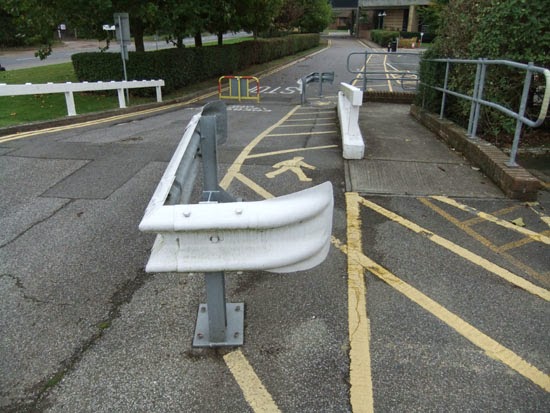
Sunday, 13 May 2018

Now, down in North Somerset:-

                  
The  A38 south of Highbridge, and elsewhere on this road.   Barriers are so positioned so that a degree of protection is provided for all modes of transport; so it can be done!  

 
             The pavement, though a bit narrow, doubles as a cycleway


 A cyclist makes use of the extra protection that is provided by the  correct positioning of the safety barriers.  This correct design it is not recognised 100 % of all cases in North Somerset; yet!  Maybe one day they will see the light.


Thursday, 10 August 2017

Even in the Ukraine & Romania.!

Protection for pedestrians and cyclists in the Ukraine


This example in Romania, the cyclist have chosen to ride in the road, but there is not a lot of traffic about.    

These two pictures were poached from a video of cycle touring made by one Daren Alff (hence the poor quality).  I recommend his series of touring videos, I am sure they will encourage enthusiastic cyclists to get out there and see the world.  If you can, go ahead before it you are retired it starts to get a bit too late in life.
              Go go go.

A10.

Some correctly applied safety/crash barriers were seen near Froxton on the A10 south west of Cambridge.  I wasn't able to take a picture myself. 

Tuesday, 13 June 2017

Barriers in Germany June 2017.


Pictures of safety Barriers in Germany
                                
Photographed from the passenger seat of a Right-Hand-Drive vehicle.

Barriers are positioned with the intention of preventing vehicles leaving the road and crashing off the bridge down into the valley. Unlike most UK barriers, they also prevent motor vehicles from hitting and cyclists or pedestrians that may also be crossing the bridge. 
     Providing that bit of extra protection (than they do in the UK) doesn't cost any more.  So why don't they do it?
   This Bundestrasser has a cycle/pedestrian way running for many kilometres along side it (as can be identified on the right of the picture).   A crash barrier has been installed, so that any vehicle out of control should be stopped by the barrier, before it crosses the cycleway.   This example also has a hand rail for pedestrians and cyclists. 


                                    Another good example of how it should be done.

Better still, let us have more routes that away from Main Roads.

Monday, 13 February 2017

Thursday, 1 September 2016

Safety Barriers installed!

Driving on the A617 (the Mansfield bypass)  one couldn't help noticing the cycle/footway that ran along side it, but also that way was protected from motor vehicles by safety barriers.

Now this is good news.  Is is this a case of the only highways unit in this country taking the trouble to follow correct practice? 


I could have taken photos, but that would have meant my having to
 stop on a busy 'A' road.  I am sure that readers of this blog will be able to recognise a safety barrier by now, and how it should be installed., even if Kent Highways don't seem to be able to (as a general rule).  Here all forms of transport are given some protection, no one misses out.

Thursday, 17 September 2015

Finberry

Dangerous Safety Barriers (again)
Dangerous to cyclists and pedestrians.

Re: The new housing development known as Finberry (Cheesman's Green)


 A nice new shared use route, but the barrier is in the wrong place. It it is obvious that if a motor vehicle 'looses-it' on the bend, then it would career into the barrier taking anything or anybody with it, crushing them against the barrier. Who designed this? What were they thinking? Don't the lives of pedestrians and cyclists count?

This is a new project, this is modern Britain, let us get it right for a change.
Put the barrier in the right place then it not only protects the most vulnerable, but it provides protection to motorists too.
It is cheaper to get it right the first time.

Ted Prangnell CTC, member of Living Streets and RoadPeace.

I would appreciate any feedback from interested parties please.


Wednesday, 17 June 2015

Accidentally correct.

Gosh! What have we here?  A crash barrier that actually protects cyclists and pedestrians,  BUT it ain't that clever because the barrier was put in place long before the cycleway was thought of. The fact that it is where it is, is purely accidental.

Thursday, 11 June 2015

Vehicle Restraint Team

Vehicle Restraint Team

Driving along the A28 in Ashford some workmen were observed busy at the side of the road.  Their large white van was signwritten (with great pride):-  "VEHICLE RESTRAINT TEAM" 

What a grand title!   What they were actually doing was installing a crash-barrier.

So their brief is to 'restrain vehicles'  nothing to suggest that they should protect other road users.  Especially pedestrians.  Set-belts could come under the description of  "Vehicle Restraints".  National Highways also refer to 'road restraints', how does one restrain a road?

What about changing their name and job description  to "Protecting other road users and pedestrians"?

Restraining vehicles ought to mean: "Slowing them down" ought it not?

Brakes are restraints.
So are wheel clamps

Monday, 27 April 2015

Accidental implementation!

Accidental implementation!

Amazingly this crash barrier is protecting the path, but the path was created long after the crash-barrier was installed.

The Street, Mersham.

Monday, 24 November 2014

Safety barriers near Chilham


Safety barriers near Chilham
Safety barriers near Chilham on the busy A28.   This footway is also used (Shared space) by cyclists in the interests of their safety.

The question is:-   Was the crash-barrier put in to protect vehicles; i.e.: prevent M/Vs from going down a bank and crashing into houses, or was it put in place to protect pedestrians?  The answer could be; 'probably', but not with the well-being pedestrians as the prime concern.  Thankfully that has been the net result, i.e.: 'a spin-off'.
Here (looking in the opposite direction) one can see that the barrier protects houses as well, which is not a bad thing.

                                             In the terms of Crash Barriers, putting pedestrians first is unusual.

Sunday, 12 October 2014

Pedestrian protection


Pedestrian protection within a factory complex
even more for the disabled.
With a strict 10 mph speed limit imposed.

Friday, 3 October 2014

Getting it right.

Getting as right as possible.

Crash barriers should offer some protection to both the motorist and the Pedestrian where possible. 
Only the cyclist is not fully catered for in this instance.

Wednesday, 16 July 2014

Barriers in Germany

More crash-barriers in Germany; July 2014.

Crash-barrier on the corner of a road junction, as it should be, designed to protect pedestrians and cyclists.


Tuesday, 10 June 2014

A correct instalation on, the A28.


Sometimes (but not often) they get it right as in this case alongside a footway, which in turn is alongside the A20 between Ashford and Charing.     

The state of the footway leaves a lot to be desired.

Monday, 31 March 2014

Barriers that do the job

This set of barriers seems to do the job

At a cross-roads in Charing, On this side of the A20 (which passes through the village), and at the mouth of the road to Pluckley.  There are similar crash-barriers on each corner, which are actually placed to protect pedestrians ~ must have been a different engineer from their normal; fellow.    Why at one place and not at so many others?

Sunday, 16 March 2014

Getting it right

Getting it right.

A different vantage point clearly illustrates that Highways can get it right, even if they didn't mean to at the time.  This section of barrier on the A2070, offers protection to pedestrians, cyclists, and motorists.   Whilst most of the rest of the barriers don't protect the most vulnerable in our society. 
   

Sunday, 5 January 2014

Safety Barrier in France.

Protecting cyclists with a barrier in not a new idea:-

This picture shows a continuous barrier which is designed to protect cyclists and pedestrians, and why not?

Photograph taken in Carnot-Plage, southern France. in 1998.

Saturday, 14 December 2013

What or who should a barrier protect?

Some barriers a fussy as to they think they should protect.  The mode of thinking is aimed solely at protecting motorists, and to Hell with pedestrians (the most vulnerable in our society). 

One can see that the barrier below might prevent a vehicle from going down a bank, but its very presence increases danger for pedestrians, and it need not have done.


Pedestrians would a barrier such as this to be really intimidating.

The barrier on the right  here (handrailing) is designed to protect pedestrians at a roundabout. BUT, it is not necessarily popular with cyclists, on or off the road.  Handrailing prevents cyclists from accessing the kerb, and it can snag handlebars.
It is not clear, at this location, whether or not cyclists should stick to the road or carry on, on the pavement  using it as assumed "Shared use"; it is signed as a route into the town centre.  Ideally what is needed is a separate bridge over the River Stour for cyclists. 


They just don't think!


Wednesday, 11 December 2013

Barrier to make cyclists feel safe


This photo was taken in Germany where they go out of their way to make cyclists feel safe. Where, despite there being a lot more cyclists, there are a lot less casualties..

Note that the barriers are on both sides of this road.

Monday, 9 December 2013

Ema;l exchanges with Kent Highways etc.

I have just re-examined this email from June which had buried and got lost in my in tray.

Obviously some people are able to 'mitigate' a lot more than others. Then
there are those who are able to assess the risks more readily than others,
and act accordingly. It should not be the case to make a situation worse
than it already is, especially as by doing so it would adversely affects the
most vulnerable in our society. If, by a simple application, the risk can
be reduced to both motor-vehicles and pedestrians (and cyclists) at no extra
cost, then why not do it? People should come first wherever possible, not
motor-vehicles.

It is quite obvious to see (on the ground, and from photographs) that some
people (whilst not 100% perfect) can do it, so why not Kent Highwaysor /our
Highways Agency?

Ted Prangnell.  Dec 2013.


----- Original Message -----
From: <Jim.Wedgbury@kent.gov.uk>
To: <tedeprangnell@btinternet.com>
Sent: Monday, June 24, 2013 3:55 PM
Subject: Re: Dangerous Barriers


Ted
You can only ever mitigate risk never eliminate it

Sent from my iPad

On 24 Jun 2013, at 16:51, "Ted Prangnell" <tedeprangnell@btinternet.com>
wrote:

> But there is no need for an added risk to pedestrians to be created if the
> barriers were designed properly. Are they saying that an additional risk
> to pedestrians is acceptable (when it could be avoided)?
>
> [cid:C956ADA8EB2044A198738343A781677A@TedPC]
> On our A251.
> [cid:B9F3FA1A57A343C4AEB22D57AAD9EB2A@TedPC]
> On the Continent.
>
> There are other correct examples, but I haven't got photos of them to
> hand.
>
> Properly designed barriers would protect both motor-vehicles and
> pedestrians, at no extra cost. People should come first!
>
>
> ----- Original Message -----

> To: 'Ted Prangnell'<mailto:tedeprangnell@btinternet.com> ; Alan
> Moultrie<mailto:alan@moultrie.co.uk> ; Brian
JIM WEDGBURY<mailto:jim.wedgbury@kent.gov.uk>
Sent: Monday, June 24, 2013 11:52 AM
 Subject: FW: Dangerous Barriers

 From our County Councillor

 xxxx

 From: Jim.Wedgbury@kent.gov.uk<mailto:Jim.Wedgbury@kent.gov.uk>
 [mailto:Jim.Wedgbury@kent.gov.uk]
 Sent: 24 June 2013 11:26

 Subject: Dangerous Barriers

 Dear XXXXy
 I have had this investigated it is more complicated than it first seems
 Kent highways carried out a safety audit on various sites throughout the
 county and discovered an anomaly in Canterbury road.
 Due to a number of high profile incidents and the need to protect
 motorists from 1 hitting the Bridge parapet direct and killing themselves
 and as well as a need to stop vehicles careering onto the motorway
 following an accident combined with the accident record at this site . all
 these meant an urgent need to put barriers in on this site. The slight
 increase in risk to pedestrians is I am advised is far out weighed by
 reduced risks in the other areas .
 I hope we can promulgate this explanation.
Safety barriers over the M2 Faversham. tn.jpg>
Safety barriers D tn.jpg


Nor does this explain the situation in Simone Weil Avenue, which is blatantly wrong.